Showing posts with label Mozart. Show all posts

Monday, May 27, 2013

Silent movies at the opera: Die Zauberflöte at the Komische Oper Berlin

It is not every day that you go to the opera and experience roughly two hours of singers hooked to a blank wall, but that is exactly what was on the menu last Saturday night at the Komische Oper here in Berlin. And it was awesome.


Stagings of Die Zauberflöte can be problematic. On the one hand, there's the traditional production, a la the Staatsoper: a good, solid fairy tale with extremely awkward misogynist and racist moments. On the other are regie productions, wherein it is attempted to make the misogyny and racism into some sort of lofty thing, which never works. The production at the Komische Oper manages to straddle the two while not making the dated awfulness of Monostatos and Sarastro too painful. How? With the aforementioned blank wall.

Picture a single huge, blank surface, which contains a number of doors for the characters to go through. Now picture everything you know about the silent film era. Now merge the two. The result is a wonderful storybook telling of the opera. The opera itself becomes a silent film: there are no props and no spoken dialogue. Instead, the recits become silent film piano (a riff on a Mozart Fantasie) with the dialogue projected onto the wall. And once the curtain goes up, that white wall becomes a riot of color and excitement, filled with strange projections of flowers, fairies, trees, houses, cats, and elephants, as well as an array of strangely geared machines, through which our heroes make their journey. The singers appear at different levels in the wall, standing on tiny platforms, hooked up with seat belts. In keeping with the silent film/storybook feel of the production, they were a mix of fantastical and '20s. Pamina wore a LBD and a Louise Brooks haircut (except for the brief time when she gave into Sarastro's assertion that women must be ruled by men, in which she was dressed in a black Victorian gown); Tamino a tux; Papageno the mustard yellow suit and straw hat of a particularly sleezy carpet salesman. The Three Ladies wore awesome coats and fabulous hats. The Queen of the Night was a giant spider. Monastatos was albino. The Magic Flute itself was a woodland fairy and Papageno's Magic Bells were bells with chubby dancing legs coming out of the bottoms.

Some things have to be seen to be believed.


Frankly, I found the production so impressive that I didn't once get sucked into the feminist rage pit that I normally do when seeing this opera.

At the heart of this Zauberflöte is Suzanne Andrade of the London-based performance company 1927. As they explain on the Komische Oper website, "At the heart of 1927’s practice is the desire to explore the relationship between live actor and animation to create dynamic and innovative live theatre. 1927 fuse, merge and mix creative mediums to create a unique performance style." This production is certainly that, a marriage of acting, animation and music that had the audience bouncing with glee.

But the music? What about the music?

Nicole Chevalier as Pamina won the night for the quality of her singing and acting. Her soprano was rich and clear, filling the entire house straight to the back. In comparison, Peter Sonn's Tamino was unremarkable, and Julia Novikova's Königen sounded a bit faint and strained (though to be fair, it must be rough work to sing that coloratura while bolted to a wall and dressed as a spider). Alexey Antonov's Sarastro was fine, as was Tom Erik Lie's Papageno. The weakest link was Monastatos, sung by Stephan Boving. Whether due to a bad night or bad training, he just couldn't fill the house. The strongest singers besides Chevalier, frankly, were the Three Ladies, sung by Mirka Wagner, Karolina Gumos and Caren von Oijen.

The Komische Oper orchestra, under Kristiina Poska, sounded excellent-and might I note that this was the first woman conductor I've seen since moving to Europe. Bravo, madama. Silent Film Piano was played by Peter Meiser, who married that genre's tinkly hilarity with one of Mozart's Fantasies in a way that made this girl grin.

All in all, if you're able to get out to the Komische Oper and see this performance, do. It was fabulous and awesome and, not least, fun. I can't praise it enough.

Monday, September 10, 2012

Song of the Week


I've been on a real Papageno kick this past week, namely because his music is catchy and infectious, I can't help but grin when I hear it (even if it IS technically suicide music in this one). I think what makes Papageno such an endearing character is that he is so human, in spite of the bird suit. He wants a partner, someone to share his life with, and he's not particularly interested in mysticism (it also helps that he basically calls Tamino a goob, which is an accurate observation). That, and he's just so endearing, you can't help but love him.

So here is the fabulous Simon Keenleyside, complete with mallard hat, bopping around the stage and lamenting his fate in life, before leaving in the midst of a pillow fight with his girl and their future children. Happy Monday, y'all. :-)

Sunday, August 19, 2012

Viennese Postcard

I have managed to fall completely, one hundred percent in love with Vienna. I love it even more than I loved Paris (which was a lot when I was 15 and not so much when I was 25). The sights! The food! The people! Vienna has an atmosphere of culture and history that Berlin lost in the last days of WW2. Oh, and it has everything-except Versailles-that I studied in college. For those who don't know, I specialized in the 18th century, with a focus on the Habsburg and Bourbon dynasties. And I'm a massive music nerd. So, you know, everything is there, all in one gorgeous package.

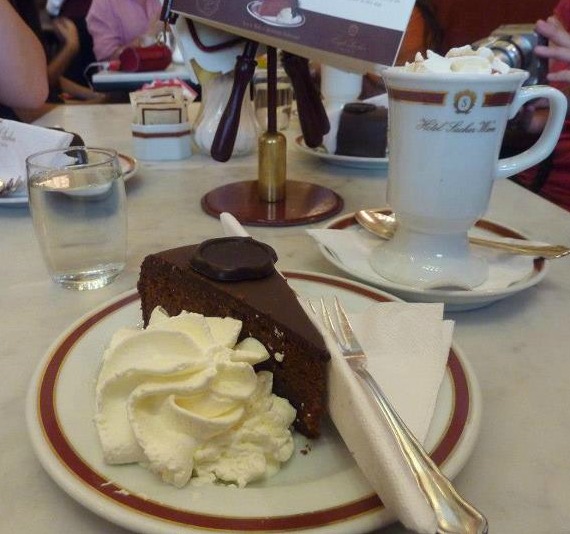
Because I am a Hopeless Romantic at heart, I succumbed to the tourist trap that is the Sacher Cafe, home of the Original Sacher Torte (they're very particular about being the Original: they took everyone else to court about it forty years ago). Sacher torte is a decadent chocolate cake with apricot jam between the layers, smothered in dark chocolate immediately after it comes out of the over. Not chocolate frosting. Pure chocolate. Oh, and that's a chococcino beside it. :-)

The nice thing about Sacher Cafe (aside from the excellent cake and the sumptuous decor) is that it's right across the street from the Staatsoper (so I could have my cake and eat it, too...). The group I was with was none too thrilled to have to go see a "boring old opera house", so we parted ways and I spent a good half hour tooling around taking pictures and trying not to buy everything in the gift shop. I, uh, didn't succeed.


Yes, that is totally a Mozart Christmas tree ornament you see there. And "Faust" starred Jonas Kaufmann the night of the poster I bought (for 50 cents-what a steal!)


This is the kind of thing you see when walking down the street in the Innere Stadt.


I found the Augustinerkirche, where the hearts of 54 Habsburg emperors live. You can't tell from the picture, but there was a man absolutely rocking out to a Bach fugue up on this organ. The whole church was shaking; it was wonderful! I love old churches and cathedrals, and how they smell of old stone and dust and the wax of a thousand candles. Love it.

Finish off the day with some yummy goulasch and a basket of bread from a tiny out-of-the-way beisl. Perfection!

Tuesday, April 3, 2012

Berlin makes me laugh so hard sometimes.

Truly, this city has some of the most awesome signage. I've taken to carrying my camera around lately, because beauties like the following just seem to appear out of nowhere.

Basic Translation: "Mozart...or Beethoven? Which composer wrote only one opera but nine symphonies? This, and two hundred other questions are in your daily copy of Die Zeit [a local newspaper]."


Note: this is the sign for the Wotan Apotheke. Apparently, their products are fit for the Norse gods. I wonder if they play Wagner inside? I would.

Monday, January 23, 2012

Great composers reimagined

Continuing in the art vein I've been in lately, let's see how people are re-imagining the Great Composers (please note, the names are links to the artist's sites):

Beethoven:

Mozart:

Wagner:

Verdi:

I promise to make a real, substantial post soon (I've got one brewing on Don Carlo), but for now, enjoy!

Wednesday, December 28, 2011

Die Zauberflote at Staatsoper im Schiller Theatre, etc.


"Die Zauberfloete" is supposed to be a fabulous blend of whimsy, philosophy, and really cool music, right? Well, yes. It also happens to be one of my less-favorite operas, and one of my dad's favorites. I saw it the other day at the Schiller Theater, in what the program informed me is an eighteen year old production. It shows. Musically, it was impeccable, but overall the production seemed tired, like a tasty cake that's been left out for too long and grown stale. Pretty enough, but not palatable.

This "Flute" was a very traditional production: Papageno was in feathers, Sarastro and Company were all Egyptian, Monostatos was in blackface. Tamino was a goob. Really, I don't think that Mozart and Schikeneder intended for their tenorial hero to come across as a meathead, but they certainly succeeded in making him such. Is it just me, or do Mozartean tenors seem to have problems with characterization? Tamino is a goob, Tito is way too nice, Don Ottavio is a schmuck. Methinks the great man preferred baritones as the heroes.

There are a few things that I dislike about "The Magic Flute", the main being Sarastro's attitude towards women. "Women are a little crazy; they need men to show them what to do." I don't think I'd have such a problem with it if my dad didn't still subscribe to this theory, and if he hadn't been quoting it at me all week. But I digress.

There were a few things that I hadn't expected in this production: the Three Ladies popped out of the dragons' mouths (there were three dragons), thus leading to the idea that Tamino had been cornered for a reason; unfortunately, this was never explored any further. Papageno and Papagena managed to produce about fifteen feather-covered children in three minutes, who then proceeded to invade the stage and make everyone laugh. But my absolute favorite part was during Papageno's suicide attempt, when he gives three signals, calling Papagena.

"Eins!" he said, and blew his whistle. "Zwei!" and blew it again.
"DREI!" shrieked a little girl in the audience, and everyone lost it.

The singer playing Papageno, Gyula Orendt, looked out at the audience for a split second; the little girl, whose voice gave her age as about five, helpfully called out "Drei!" again.
"Drei!" he repeated, once everyone had stopped giggling.

Also funny was the little boy who spent the second act hanging over the back of my chair, right between my dad and I, wide-eyed and slack-jawed. He was four, his mom informed me, and had seen the children's version, but wanted to see the real thing. He was completely, totally glued. Adorable.

Musically, the production was impeccable. Sarastro was sung by Alexander Vinogradov, whom I saw as Basilio in "Barbier" here in October. He seems to be a fixture at the Staatsoper; he's very good, so I'm glad. Tamino, sung by Stephan Rugamer, was less good, but this is more character-related than anything, so I'll let it pass. Katherina Muller's Pamina was just fabulous, full-voiced and spunky. The Queen of the Night was sung by Iride Martinez, and she pwned everyone.

Bottom line: four out of five stars to the singers, and two out of five to the production. Dear Staatsoper: hire yourself a new director and get a new "Flute". You've earned it.

Monday, November 14, 2011

Berlin: Tiergarten

I went exploring in Tiergarten, Berlin's answer to Central and Golden Gate Parks, this past weekend. It was beautiful, all fall foliage and black-water lakes (not a little creepy, but atmospheric). I only got through half the park, walking for about an hour, but I stumbled upon this lovely memorial to three great German composers: Haydn, Mozart, and my own dear Beethoven:


The memorial, a discreet sign explained in four languages, was constructed sometime in the 1850s. It was damaged during the First and Second World Wars (Mozart bears a few bullet holes, as does Haydn's pedestal), and parts of it went missing. But, in true German spirit, the whole thing was restored in the decades following the cease-fire. They replaced the gilding and the missing swan's necks, made a new pedestal out of marble from the original quarry, and made an elegant little garden out of the area. It looks like it would be a nice place to have summer concerts.

If you look closely, you can see what looks like little black spots all over Herr von Beethoven's face. They're actually some sort of insect. Of the three composers honored, Beethoven was the least spotty.

Thursday, September 8, 2011

*sob*


The Staatsoper is undergoing refurbishment, which means that all of its operas are taking place at the smaller Schiller Theatre. Such a beautiful building! I know that the restoration is very important, but I want to see an opera in the actual Staatsoper! *wails*

On the candy-colored boards surrounding the construction site are lots of adds for the upcoming shows. I like this one best (it makes me laugh):

Tuesday, September 6, 2011

Don Giovanni: Commendatore


I have always loved that when the Commendatore's statue walks onstage, Don Giovanni's initial reaction is, "Well, damn. I didn't see that coming".

I was raised with Don Giovanni in much the same way I was raised with Figaro. Driving to the orthodontist, my dad would put on his favorite recording of the opera and play all the highlights: the overture, Leporello's intro through the Don's entrance, the Champagne Aria, the Finale. And I would sit there, glued, listening to Samuel Ramey and Ferruccio Furlanetto be amazing. Those two basses will always be MY Don Giovanni and Leporello.

For some reason, we never really listened to the Act One finale, which I discovered on my own in university, and which is frankly my favorite part of the entire opera.

Here I give you this AMAZING Commendatore scene, from Franco Zeffirelli's 1990 production for the Met. It's amazing that the stage didn't explode from so much awesome.